
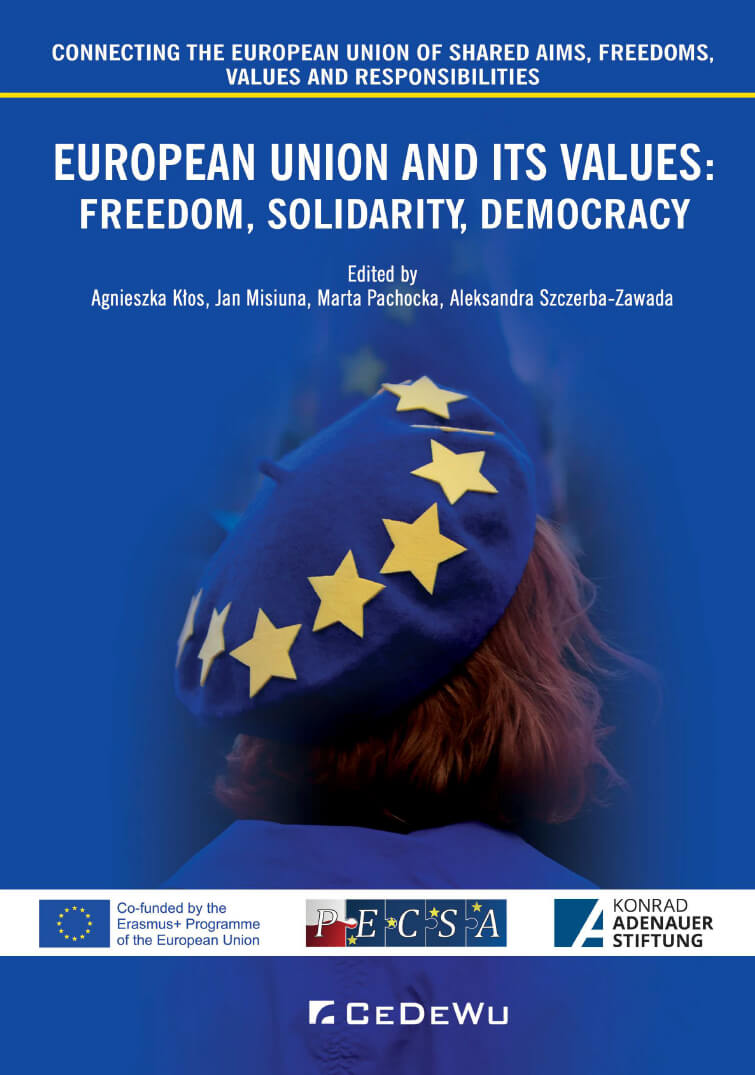
European Union and its values: Freedom, Solidarity, Democracy
Recent years have seen numerous challenges to the European Union and its functioning. These have concerned both the situation in some Member States but also the relationship between national governments and EU institutions. Much attention has been paid to the issues of border control, migration, and asylum because of the migration situation within the EU and its neighbourhood, as well as to the rule of law, human rights, and the judicial system in member countries.
In dynamic national, regional, and global conditions, it is necessary to discuss the foundations of the European Union and its basic values such as freedom, solidarity, and democracy. Such analysis should be multidimensional, covering both legal and institutional matters at different levels of governance, as well as the implementation of specific practices and policies.
The success of integration processes in Europe is dependent upon the mutual trust built into axiological foundations that allow the EU Member States and their societies to cooperate and the EU to act as a united, although diversified actor. In this context, special attention should be paid to the contribution that academia can make to policymaking to support and protect the shared European values of human dignity, freedom, democracy, equality, the rule of law, and respect for human rights—values that represent the foundations of any free and democratic society.
The complexity of the European Union is reflected in the variety of topics addressed in the presented book from an interdisciplinary perspective. Among the contributing authors are researchers from Poland and abroad who approach the subject matter from their backgrounds in law, political science,
international relations, and others. The issues they explore were discussed at the PECSA International Conference “Connecting the European Union of shared aims, freedoms, values and responsibilities” on 5 December 2019 at SGH Warsaw School of Economics (Poland). Both the conference and this
book were prepared with the support of the Erasmus+ Programme of the European Union within the scope of the EUSHARE project “Connecting the European Union of shared aims, freedoms, values and responsibilities”, which was implemented by the Polish European Community Studies Association (PECSA). This was only possible thanks to fruitful cooperation between many institutions and exceptional people. Therefore, we would like to express our very great appreciation to all of them, believing that this book is an important voice in the discussion on the EU today and in the near future.
Please find below the chapter of our professor Denard Veshi, PhD in the book (Chapter 6, pp. 61-69 is his contribution):
You may also like


Symposium 2023 Gallery
